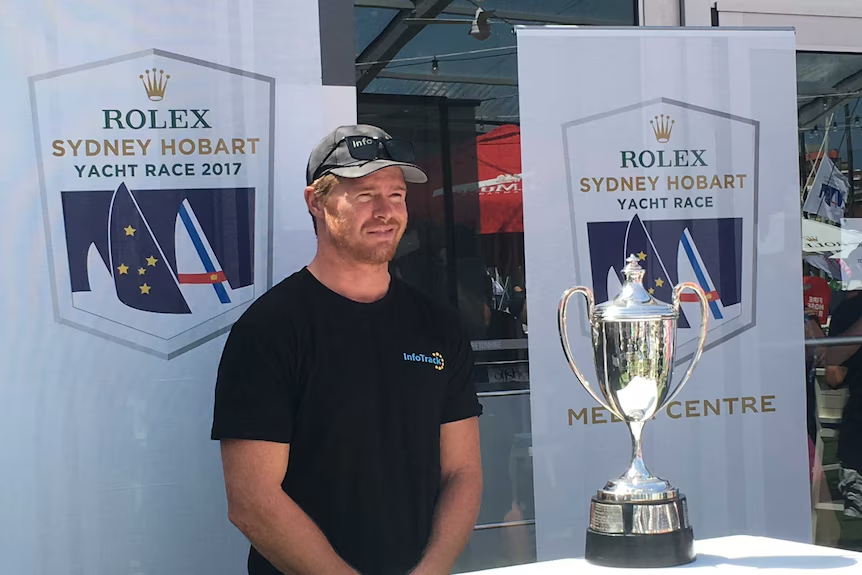
Long before he won the Sydney Hobart, Tom Slingsby was already an Olympic champion. His memory of how Australians judged him raises a question worth asking: Why doesn’t success in one part of sailing always command the same respect in another?
By the time Tom Slingsby first sailed the Sydney Hobart, he had already won Olympic gold and a string of world titles. Yet he remembers that, at home in Australia, those results were measured against a different yardstick.
“I remember when I was younger; I had won Olympic gold and many world titles, but if I was ever in Australia, the one question I was asked was ‘how many Hobarts have you won?'” Slingsby said ahead of this year’s race. At that stage, he had not won the race. He had never sailed it.
He has answered that question many times over since. Slingsby has raced to Hobart five times and took line honours with Anthony Bell’s Perpetual Loyal in 2016, setting what was then the race record of 1 day, 13 hours, 31 minutes and 20 seconds. Since then he has added three SailGP championships to an Olympic gold medal, an America’s Cup win and three World Sailor of the Year awards.
So his memory is not a complaint about today. It is something more interesting: a glimpse of how sailing decides what counts.
Back to Hobart, a Decade On
Slingsby returns to the Sydney Hobart this Boxing Day after close to a decade away, as sailing master aboard Bell’s Tribeca Loyal, the former Comanche and the holder of the current race record. He sailed with Bell from 2013 through the 2016 line honours win, and fellow SailGP and America’s Cup sailor Sam Newton, a graduate of the CYCA’s Youth Sailing Academy, joins him on board.
“This boat already owns the Sydney Hobart race record,” Slingsby said at the boat’s launch, “but if we get the right conditions, we can break that record by a lot.”
Tribeca Loyal is one of four 100-footers chasing line honours, alongside Christian Beck’s InfoTrack, Mark Richards’ Palm Beach XI and Grant Wharington’s Wild Thing 100. The full fleet for the 81st edition stands at 100 yachts, including 16 double-handed entries and 12 women owner-skippers.
Different Disciplines, Different Currencies
Slingsby’s question points to something every competitive sailor understands, even if it is rarely said aloud. Each part of the sport has its own currency of respect.
Olympic sailing rewards individual technical mastery and consistency across a regatta. SailGP rewards speed, precision and split-second teamwork in front of a global audience. The America’s Cup prizes innovation as much as sailing. Offshore racing values endurance, preparation, seamanship and trust in the people beside you. Club racing earns its reputation through years on the same start lines among the same rivals.
None of these is a lesser achievement. But they are not easily exchanged. An Olympic medal tells sailors something precise about a person’s ability in a dinghy. It does not tell them how that person behaves at 3 a.m. in Bass Strait, with the boat slamming and the nearest help hours away. In the Australian sailing circles Slingsby describes, that second question carried particular weight.
An Olympic medal says something precise about a sailor. It doesn’t say how they handle 3 a.m. in Bass Strait.
Why the Sydney Hobart Carries Such Weight
Part of the answer is history. This is the 81st Sydney Hobart, and the Boxing Day start from Sydney Harbour is woven into the Australian summer in a way few sailing events anywhere can match. Plenty of Australians who have never watched an Olympic dinghy race know what it means to sail to Hobart.
Part of it is shared experience. Slingsby put it simply: “When you do a Rolex Sydney Hobart Yacht Race with someone, you are friends for life. Trust is a huge part of any successful team.” The race asks crews to rely on one another over days, not minutes, and the respect it earns is personal as much as sporting.
And part of it is that the race belongs to everyone in it. The same fleet that includes four 100-foot maxis includes Jiang Lin, who last year became the first woman, and the first double-handed entry, to win the Tattersall Cup overall. She returns this year with a brand-new JPK 10.50, also named Min River, sailing with Alexis Loison. Felicity Nelson will start her 30th Hobart aboard the Sydney 36 Supernova, which would make her only the second woman after Adrienne Cahalan to reach that mark. A world champion and a 30-race veteran face the same course and the same Bass Strait.
More Connected Than It Looks
It would be easy to read Slingsby’s story as proof that sailing’s disciplines are drifting apart. The evidence points the other way.
The technology divide is less tidy than it seems. Many Olympic classes, including the Laser, now known as the ILCA 7, in which Slingsby won Olympic gold, do not foil at all. Meanwhile, offshore racing has its own cutting edge, from foiling IMOCAs in the Vendée Globe to the record-breaking supermaxi Slingsby will sail next month.
The commercial worlds overlap too. Rolex is principal partner of the Sydney Hobart and title partner of SailGP, backs the World Sailor of the Year awards, and counts Slingsby himself among its sailors. And he is far from the only sailor to cross between disciplines: Peter Burling, Blair Tuke and Ben Ainslie have all moved between Olympic campaigns, the America’s Cup and SailGP.
What Slingsby’s story shows is not a sport splitting apart. It is a sport whose parts value different things, and whose best sailors increasingly collect respect in more than one currency.
The Question Behind the Question
“How many Hobarts have you won?” was never really about a trophy count. It was a way of asking whether a sailor had been tested in the conditions that a particular sailing culture respects most.
Slingsby has now answered it, along with almost every other question the sport can ask. When he leaves Sydney Harbour on December 26 aboard the Sydney Hobart’s race record holder, he will be chasing a second line honours win and perhaps a new record. He will also be a reminder that in sailing, reputation is earned many times over, and in many different places.

