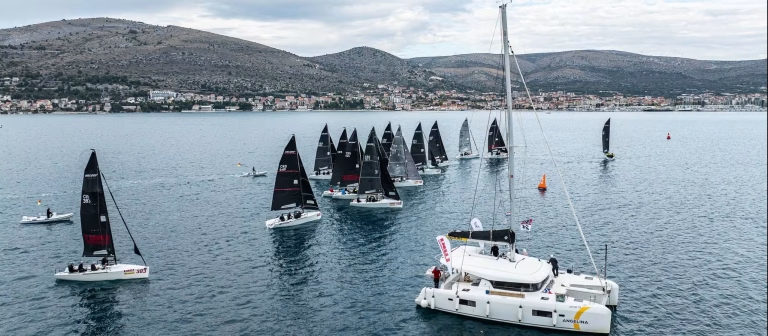
The SSL Snipe Challenge burst into life on Guanabara Bay as two-time Snipe World Champion Bruno Bethlem secured a direct berth in the final after dominating four qualifying races in Rio de Janeiro. Sailing with Daniel Claro, the Brazilian topped a 32-team fleet drawn from 12 countries, posting eight net points to lead the competition that forms part of the SSL Gold Cup 2026 programme.
Bethlem and Claro constructed their advantage with a third place in the opening race, followed by a 15th, a second and another third. After discarding their worst result, they finished five points clear of Manu Hens and Alexandre Tinoco. That team, entered for Belgium, won the third race and ended the day on 13 net points. Under event rules, the second-placed team advances directly to the semi-final.
Spain’s Alfredo González and Cristian Sánchez sit third on 18 points, tied with Brazil’s Bernardo Pereira and Caio Nogueira. Mateus Tavares and Flavio Castro are fifth on 19 points, level with Henrique Haddad and Felipe Haddad in sixth.
A defining feature of the SSL Snipe Challenge is its extraordinary line-up of world-class sailors spanning different generations. Bruno Bethlem won World titles in 2009 and 2013, Alexandre Tinoco won in 2011, Mateus Tavares was champion in 2015 and Alfredo González lifted the trophy in 2022. The fleet also includes Ernesto Rodriguez, the 2026 World Champion, alongside Augie Diaz of the United States and Nelido Manso López of Cuba, among other internationally accomplished sailors.
The event also reunited sailors who have crossed paths at Snipe World Championships over the years. Among them is Henrique Haddad, who won the 2019 Snipe World Championship in Ilhabela, São Paulo state, with Gustavo Nascimento. Seven years on, he is back racing with his brother Felipe Haddad in the same boat he won the World title in, a 25-year-old hull.
The Star Sailors League was already involved in the 2019 Snipe Worlds, supplying the sailors’ identification bibs displaying names and countries. The bibs help bring athletes closer to the public and are part of the concept SSL has developed for its international events.
Henrique Haddad sees the Snipe as a crucial stepping stone for developing sailors who go on to race bigger boats. “The Snipe is our school boat. It’s raced at a very high level here in Brazil, and also in countries like Spain and the United States. It’s definitely a great school for sailors. We had some tough races today, especially the last two. The standard of the event is very high, and it’s great to see this kind of battle, with some doing well and others struggling,” said Henrique Haddad, known as “Gigante”.
Among the Brazilians, three-time Women’s Snipe World Champion Juliana Duque also secured her place in Wednesday’s knockout stage. Sailing with Rafael Martins, with whom she won gold at the South American Games in Santa Fe, Argentina, in September this year, the pair finished the opening series in tenth place with 26 net points.
“It’s been really good because the level is very high. Today was a tough day with four races. We sailed the first two well, but in the third we got our tactics wrong and had to fight back. In the last one we had a good race, but it got away from us. We’ve qualified for tomorrow, and now it all starts again,” said Juliana Duque.
She won her three World titles with three different partners: in 2016 with Amanda Sento-Sé in Bracciano, Italy; in 2021 with Mila von Beckerath at the Guarapiranga Reservoir in São Paulo; and in 2023 with Bruna Patrício in Valencia, Spain.
Several other teams provide a direct link between the Snipe and the Brazilian squad racing in the SSL Gold Cup. Three-time Junior Snipe World Champion Mário Tinoco, who won in 2005, 2007 and 2009, is sailing with Catarina Glashester. They finished qualifying in 19th place and will get another chance in the repechage.
“It’s a great pleasure to have an event like this at home and to see friends we don’t often get the chance to meet. It’s really good to be here, racing and also training on the SSL Gold Cup race area ahead of the event in the coming weeks,” said Mário Tinoco, a member of SSL Team Brazil.
Another Brazilian in the fleet is Juninho de Jesus, sailing with Anderson Brandão. The pair finished the first four races in 15th place with 35 net points. “This event brings together the cream of world Snipe sailing. It’s great to take part in something like this, especially here in Brazil. It’s an opportunity very few people get. I’m really happy to be here with everyone,” said Juninho de Jesus, who is also part of Brazil’s SSL Gold Cup team.
South Africa’s Ian Ainslie showcased the remarkable range of experience among the sailors gathered in Rio. A three-time Olympian in the Finn class, he arrived in the city on Monday night and sailed a Snipe for the first time during the competition. Sailing with Olivia Purchase, Ainslie finished qualifying in 27th place. Despite the difficult start, the coach of South Africa’s SSL Gold Cup team stressed the value of racing against class specialists.
“We arrived the night before and had never sailed these boats. It was our first day, and we could see that everyone was at a very high level. We started at the back of the fleet but managed to improve through the day. It was great fun,” said Ian Ainslie.
Ainslie knows the conditions on Guanabara Bay well. As Olympic coach for the Netherlands, he spent three years living in Urca, in Rio’s South Zone, preparing sailors for the Olympic Games. He now plans to use that experience in his national team’s campaign. “I’ll try to pass on to the team what we learned about the wind and current here. We know these conditions well from the training we did in Rio,” he explained. South Africa makes its debut this Thursday in the second stage of the World Cup of Sailing.
In traditional Snipe championships, the final ranking is decided by adding up results across the series. The SSL Snipe Challenge instead uses a knockout system inspired by the SSL Gold Cup, meaning the title comes down to a single race, regardless of the points scored before it.
Wednesday’s programme starts with the repechage, scheduled for 11:00, with knockout rounds beginning at midday. The qualifying series winner goes straight to the final, while the second-placed team earns a semi-final spot. Teams finishing third to tenth race in the quarter-finals, joined by the top two boats from the repechage.
In the quarter-finals, ten boats compete for five places in the semi-final. The semi-final features six boats, including the team that has already qualified, and the top three advance to the final. In the deciding race, four boats start together and the first to cross the finish line wins the SSL Snipe Challenge.
The event is organised by the Iate Clube do Rio de Janeiro with the support of the Star Sailors League. It is part of the SSL Gold Cup 2026 programme, based at AXIA Marina da Glória.
After the SSL Snipe Challenge final, attention returns to the national-team racing of the World Cup of Sailing. On Thursday the SSL Gold Cup 2026 begins its second stage, the 1/16 Finals, with 16 countries taking part. Portugal, Ukraine, Tahiti, Lithuania, Estonia, Malaysia, Uruguay and Myanmar advanced from the first stage, which ended on Sunday. They will now face Hungary, Ecuador, Chile, South Africa, Thailand, Japan, Peru and the Czech Republic, who enter directly at this stage based on their Star Sailors League ranking.
SSL Team Brazil, led by two-time Olympic champion Robert Scheidt, enters directly at the 1/8 Finals from 2 to 5 December, in a group that also includes Poland and two teams that qualified from the earlier stages.
Mário Tinoco spoke about looking forward to stepping back aboard the SSL47 for the World Cup on home waters. “You always want to get on the boat, but I’m keeping my nerves in check. I think it’s going to be great. The team is really united, our expectations are high, and racing at home is very special. We’re going all in,” said Mário Tinoco.
The quarter-finals will take place from 7 to 10 December. The semi-finals are on Saturday the 12th, and the final is on Sunday the 13th, when four nations will race a single race for the world title on Guanabara Bay.
Created in 1931 by American William Crosby, the Snipe is one of the most traditional classes in world sailing. The one-design boat is 4.72 metres long, carries two sails — mainsail and jib — and is sailed by two people, a helm and a crew. Because all the boats follow the same design, performance depends mainly on technique, tactical decisions and teamwork.
Brazil has a long history in the class. The Snipe helped develop Olympic medallists such as Torben Grael, Lars Grael and Robert Scheidt, as well as world champions such as Bruno Bethlem, Alexandre Tinoco, Mateus Tavares and Henrique Haddad. The class brings together sailors of different generations, from young sailors still learning to athletes with Olympic and international experience.