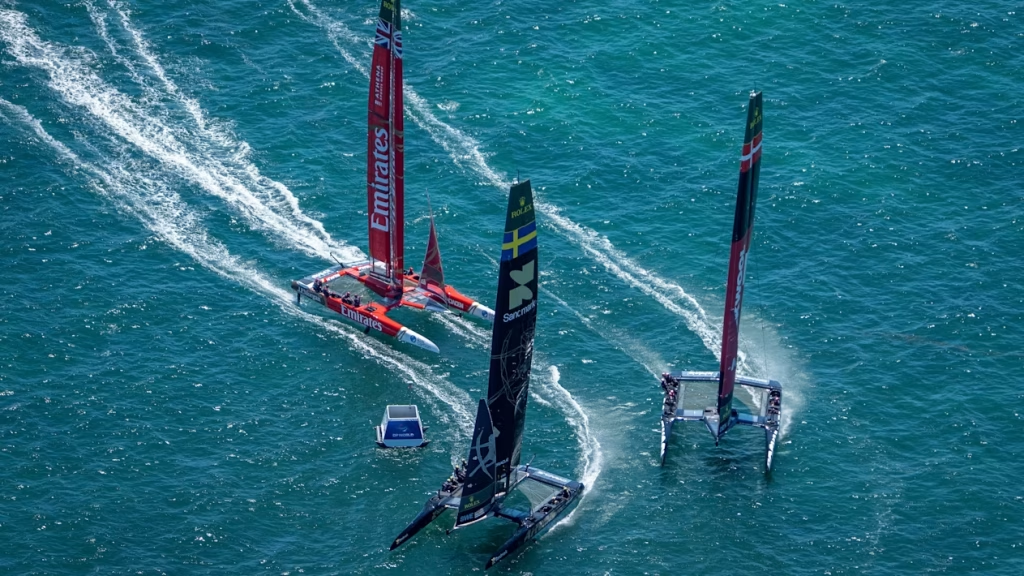
For aspiring high-performance sailors dreaming of stepping aboard one of the fastest racing yachts ever built, there is one non-negotiable requirement before anything else — a SailGP Super License.
The United States SailGP Team recently highlighted the credential as the essential first step for anyone looking to compete aboard the league’s iconic F50 foiling catamaran, a vessel capable of exceeding 50 knots and pulling forces that rival those experienced by Formula 1 drivers. But what exactly is the SailGP Super License, and what does it take to earn one?
The Gateway to the World’s Fastest Sail Racing
The SailGP Super License is the league’s proprietary certification system, designed to ensure that every athlete who sets foot on an F50 catamaran possesses the physical fitness, technical skill, and safety awareness required to operate in one of the most extreme environments in professional sport. The F50 is no ordinary racing yacht. With its rigid wing sail, hydrofoiling daggerboards, and flight control system, the boat demands split-second decision-making at speeds that leave virtually no margin for error.
The licensing program was developed in response to the unique dangers posed by foiling multihulls at high speed. Unlike traditional keelboat racing, where capsizes are rare and speeds are moderate, the F50 regularly flies above the water surface on carbon fiber foils, creating scenarios where a mistake can result in dramatic and potentially dangerous crashes. SailGP has invested heavily in safety protocols, and the Super License sits at the center of that framework.
What the Certification Involves
While SailGP does not publicly disclose every detail of its licensing criteria, the process is known to involve multiple components. Candidates must demonstrate extensive experience in high-performance sailing, typically at the international or Olympic level. Physical fitness testing is also part of the equation, as grinding and maneuvering on the F50 places extraordinary demands on the human body. Crew members routinely experience forces exceeding 3G during high-speed maneuvers, and the physical endurance required to sustain performance across an entire race day is considerable.
Additionally, candidates undergo simulator training on SailGP’s proprietary systems, learning the boat’s flight control interface and emergency procedures before ever stepping aboard the real thing. The simulator replicates the F50’s handling characteristics with remarkable fidelity, allowing athletes to build muscle memory for critical scenarios such as nosedives, sudden wind shifts, and foil ventilation.
A Growing Pathway for American Sailors
The U.S. SailGP Team’s emphasis on the Super License comes at a time when the American squad is actively developing its talent pipeline. Under the broader SailGP Inspire program and various national development pathways, younger sailors are being groomed to eventually meet Super License standards. With SailGP continuing to expand its global calendar and the competition between national teams intensifying season after season, the demand for qualified F50 athletes has never been higher.
For the United States team, cultivating homegrown talent capable of earning the credential is a strategic priority. The pathway from youth sailing through Olympic classes and into SailGP represents one of the most clearly defined career trajectories in modern professional sailing.
The Broader Significance
The Super License concept mirrors credentialing systems in other elite motorsport leagues, most notably Formula 1’s own Super License, which restricts entry to drivers who have proven themselves through lower categories. SailGP’s adoption of a similar model underscores the league’s positioning as the pinnacle of professional sail racing — a sport where raw talent alone is not enough, and where safety, preparation, and proven competence are prerequisites for participation.
For sailors watching from the sidelines and wondering what it takes to ride an F50, the answer begins with three words: earn the license.
Source: View original post on SailGPUSA
