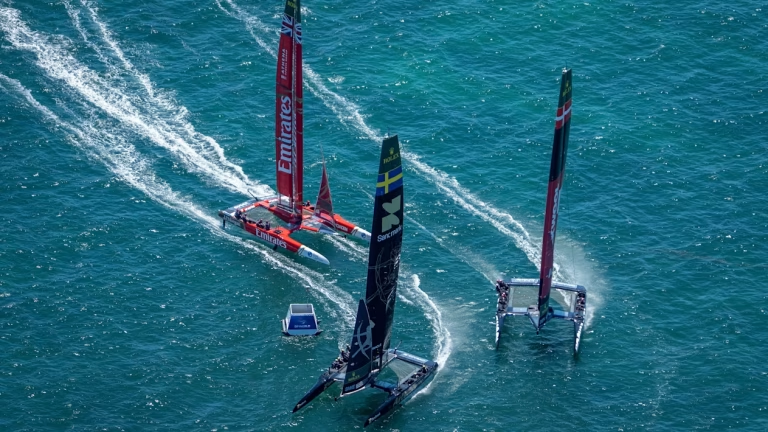
Emirates Team New Zealand raised eyebrows in today’s Recon footage by taking their new ETNZ M2-1 mainsail out for testing in surprisingly light conditions. The casual observer might question why a double-skinned sail built for heavier airs would be trialled in such underpowered winds. But as with most things in the America’s Cup, there is method behind the approach. Let’s dive into what the Kiwis could really be looking for.
The most plausible baseline objective is establishing the crossover point between the M1 and M2-1 mainsails. Testing the M2-1 in such light conditions suggests Emirates Team New Zealand may be particularly focused on the lower boundary of the sail’s operating range. For Taihoro, the critical question is whether the new M2-1 can generate sufficient power to take off, accelerate, and remain foil-borne in conditions where the larger M1 would traditionally hold an advantage.
This is a fundamentally different exercise from testing the M2-1 in 15–18 knots, where excess power and drag reduction take priority. At 6–8 knots, as the Recon team recorded during the first part of today’s session, ETNZ is likely examining three distinct performance regimes. First, the displacement-to-foiling transition: can the M2-1 generate enough aerodynamic force to achieve take-off? Second, in marginal foiling conditions, once airborne, can it maintain stable flight through lulls, manoeuvres, and changes of heading? The team was seen performing plenty of manoeuvres today. Third, in steady-state foiling, once established on the foils, does the M2-1 produce better VMG than the M1 despite its smaller area?
This last question is where the VPP (Velocity Prediction Programme) and its polars — the boat’s predicted speed across different true wind speeds and angles — become particularly interesting.
If the new M2-1 can achieve the same steady-state VMG as the M1 in 7–8 knots, that would be a significant result. It would suggest that the smaller mainsail’s potential aerodynamic efficiency advantage is sufficient to compensate for its reduced area, even when the boat is relatively underpowered. That could give ETNZ a much wider usable wind range for the M2-1.
However, there is a critical complication. A sail can produce better VMG once airborne while being worse at getting the AC75 onto its foils in the first place. That means ETNZ may need two separate crossover assessments — one for take-off and another for sustained foiling performance.
The VPP may be most inaccurate at the bottom of the wind range. In steady flight, it can predict a balance between aerodynamic driving force, hydrodynamic resistance, and the loads supported by the foils. But at 6–8 knots, small changes in sail force can produce disproportionately large differences in performance.
A yacht might accelerate successfully to take-off speed with the M1 but struggle with the M2-1. Take-off might be fine with either mainsail, but sailors may find they can maintain flight more consistently with one. The team might achieve a higher peak speed with the M2-1 but suffer more frequent touchdowns, or they may produce superior upwind VMG with the M2-1 but lose that advantage after tacks.
These are not minor differences. They can determine whether a sail is viable in a light-air race. The design team will therefore be keen to compare predicted polar performance against the probability of actually achieving and sustaining those speeds. A conventional steady-state polar does not fully capture take-off time, touchdowns, and manoeuvre losses. ETNZ would need additional transient-performance analysis or empirical corrections to account for those factors.
One theory is that ETNZ has improved the M2-1’s aerodynamic efficiency enough to challenge the M1 in marginal conditions. Today, the designers and sail team could have been examining all manner of inputs such as lift-to-drag ratio, camber distribution, jib interaction, aeroelastic behaviour, or sheer acceleration. At 6–8 knots, the objective may have been to establish the minimum viable aerodynamic force required for take-off and then determine whether the M2-1 can deliver it more efficiently than predicted.
Another strong possibility is that the sail was being tested deliberately outside its expected operating range. Design teams do not always test a sail in conditions where they expect it to be fastest — sometimes the purpose is to expose weaknesses in the model. If the VPP predicts the M2-1 should be significantly slower than the M1 at 6 knots, the designers can use a marginal-wind session to investigate whether the predicted performance deficit is real, or whether alternative trim settings can recover some of that deficit. They might also be looking at whether the model accurately predicts the yacht’s take-off threshold, or whether performance differences are attributable to the mainsail or to the foil and flight-control settings. A failed test could be extremely valuable if it identifies why the theoretical model differs from reality.
Manoeuvring performance may ultimately matter more than polars. Today’s session saw the sailors executing a lot of snaking S-manoeuvres and turns, similar to how they sailed on the 8th of October when Seb Menzies specifically highlighted the importance of high turn rates and low-speed manoeuvrability. The 12th of October Recon report then recorded sailing in approximately 4.5–8 knots with the M2 mainsail, J2-1 and later J3-1 jibs. That report suggested the team took almost two minutes to take off before practising tacks, gybes, 360-degree turns, pre-start manoeuvres, and longer speed runs.
Both of those days, along with today, suggest an important second objective alongside polar validation — understanding how the M2 sail plan performs when the yacht is forced away from its optimum steady-state sailing mode. An M2-1 might have excellent straight-line polar predictions but lose more speed in an aggressive pre-start turn than the M1. Equally, a more efficient sail could help Taihoro accelerate out of a manoeuvre, even if its absolute maximum driving force is lower.
For match racing in Naples in 2027, that could be decisive.